
by Chris DePuy / September 14, 2026
Late Sunday evening Pacific time, Mia AI Lab pushed a four-rank serving profile for DeepSeek-V4.1-Flash to its DGX Spark recipe, the same lab whose September 13 post on X put the model on four DGX Sparks and invited readers to run the stack themselves. The significance is not in the row of new numbers. When this blog covered the recipe’s debut two days ago, the four-machine configuration existed only as a profile the README described as validated for configuration but never started up. The commit log now shows the profile shipped and marked tested at 5:20 a.m. UTC this morning, in the repo’s own words: “settings are tested; 1M-context needle passed.” I read the four-rank build as the moment the deskside cluster stops being a fitting exercise for a 500-billion-class model and becomes a capacity machine — and the figure that proves it is not a token rate.
Mia AI Lab: what the shipped four-rank profile actually carries
The recipe serves DeepSeek-V4.1-Flash — a 552-billion-parameter mixture-of-experts model that activates 8 billion parameters during prefill and 16 billion during decode, with the 196-billion-parameter Engram conditional-memory table kept on NVMe rather than in unified memory — through SGLang on four GB10 modules over a ConnectX-7 RoCE fabric. The weights run MXFP4 in the routed experts and FP8 in the dense layers; DSpark handles speculative decoding; tool calling and vision are live; and everything sits behind one OpenAI-compatible endpoint. The shipped profile pins context at 1,048,576 tokens, the model maximum; an 8,000,000-token key-value pool at 13.4 GB of cache per rank; eight running requests; 1,024-token prefill chunks; and a static-memory fraction of 0.80 that leaves roughly 24 GiB per rank free of the pool for the long-context prefill transient. The chunk size is arithmetic, not taste: the recipe documents the indexer’s per-chunk transient at about 15 GB for a 1,024-token chunk at full context versus roughly 60 GB at 4,096, which a 121.7-GiB module cannot carry. The verification is the line worth quoting: a needle-in-a-haystack test at the full million-token envelope passed — the README’s phrase is “verified end to end rather than extrapolated.”
Why four ranks beat three: the padding arithmetic
The comparison table in the same README explains the gain without invoking any new kernel. Three-way tensor parallelism does not divide the model evenly: 64 attention heads, 8 groups and 128 draft experts all need padding (heads to 96, groups to 12), and the third rank’s attention shard is entirely padding. Four-way parallelism divides exactly — 16 heads and two groups per rank, no padded GEMMs — which drops resident weights from about 101 GiB to about 77 GiB per GPU and leaves roughly 40 GB of headroom per rank while serving, against the three-rank layout’s single-digit gigabytes. The maintainers measure the consequence in decode: 45.4 tokens per second single-stream prose at 212 milliseconds to first token, 103.1 aggregate at four streams, 114.1 at eight and 134.2 at sixteen, where their own note is precise that sixteen streams is a throughput operating point rather than a latency one — time-to-first-token stretches to 2.70 seconds at eight and 12.45 seconds at sixteen. Prefill holds between 3,251 and 3,782 tokens per second from 4K through 128K prompts, peaking near 16K–32K inputs. The extra NIC hop costs nothing net: the recipe states that smaller attention GEMMs and the absence of padding “more than pay for” the additional ring traversal, at 104 NCCL collectives per step on both layouts. Two operational constraints travel with the build, both documented rather than discovered: a Spark’s two ConnectX-7 ports make a three-node triangle but not a four-node mesh, so the four-rank fleet needs a RoCE switch, and SGLang’s speculative-family admission delayer has to be disabled by explicit flag or eight configured requests quietly become seven.
The community receipt, and the second four-rank stack
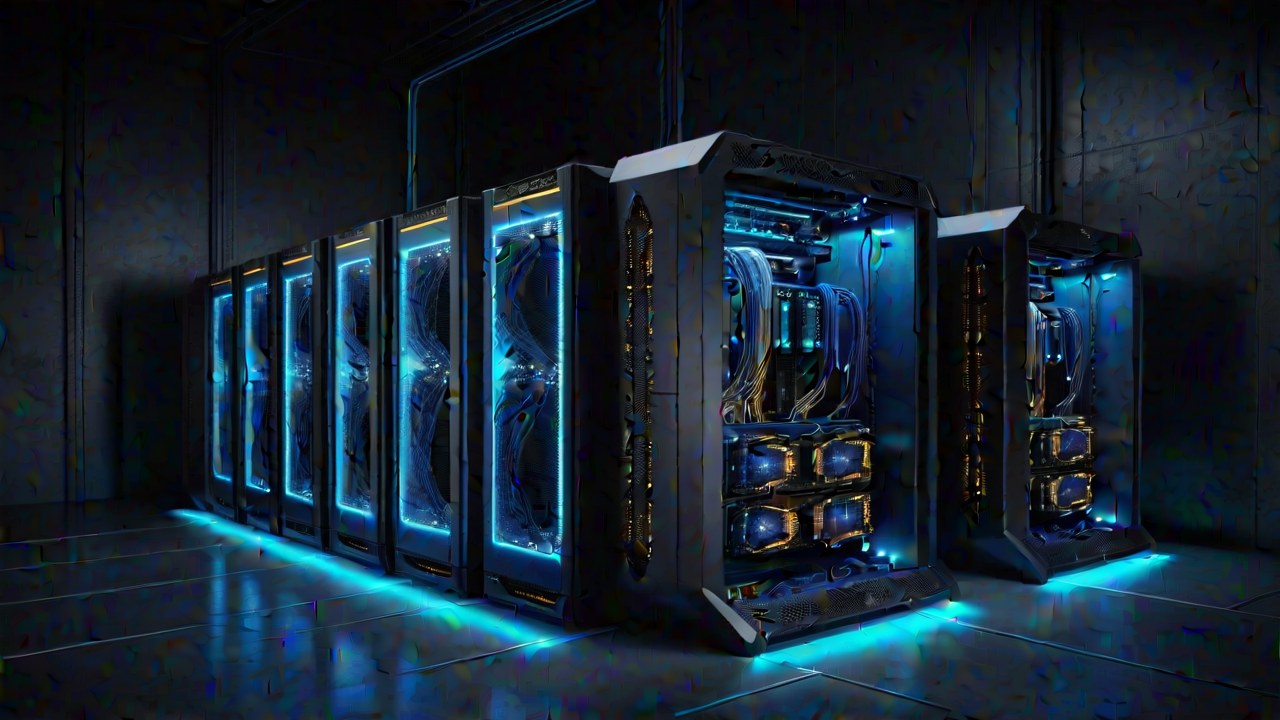
The launch travelled faster than the commit. Alongside Mia AI Lab’s post, a quoted community post photographed four Sparks racked together running the model with the warning that stacked together “they run genuinely hot” — thermal color, community-reported, consistent with what four loaded GB10 modules draw. The four-rank deskside tier is no longer a single stack’s claim: the vLLM four-machine recipe from the model’s release day published 73.8 tokens per second single-stream on code with the Engram tables on disk, and it and this SGLang build are converging on the same footprint from different engines. The practical read for a buyer: what distinguishes four-Spark deployments now is not whether the model fits — both stacks prove it does — but which one carries the verified 1M-context envelope, the concurrency ladder and the memory receipts. Today that documentation belongs to the SGLang profile.
| Config | Resident weights per rank | Headroom while serving | Verified envelope | Measured performance | Best for | Source |
| 3× DGX Spark, SGLang TP3 | ~101 GiB (padded shards) | ~6 GB | 208K single-prompt, 750K-token KV pool | 37.9 tok/s prose single-stream; 78.6 aggregate at 4 streams | community benchmark | |
| 4× DGX Spark, SGLang TP4 | ~77 GiB (exact partition) | ~40 GB | 1M context, needle test passed; 8M-token KV pool | 45.4 tok/s single-stream; 103.1 aggregate at 4 streams; prefill 3,251–3,782 tok/s | community benchmark | |
| 4× DGX Spark, vLLM (day-one stack) | 81.6 GiB | Engram on NVMe per worker | 1M path booted separately; 1.07M-token pool at 300K | 73.8 tok/s code single-stream; 131.9 aggregate across 8 categories | community benchmark |
As firms such as 650 Group have been tracking in their AI infrastructure research, the deskside cluster tier is maturing through release engineering — shipped profiles, pinned settings, passed needle tests — rather than through first-boot screenshots, and that paperwork is now the part worth comparing.
A separate batch of .md notes on the JSPARK3 “Tempo” three-Spark vLLM/EXL3 comparison against this same DeepSeek model is pending a dedicated post, as is the second round of single-Spark Qwen3.8-27B recipe speedups with its top-ranked community agentic-quant benchmark, the GLM-5.3-Flash two-Spark EXL3 kit’s v1.5.0 and six-fix maintenance rounds, the heterogeneous prefill-and-decode split’s doubled context window, and the still-open agent shared-memory and second-brain notes.