
by Chris DePuy, 650 Group / November 5, 2026
On November 4, 2026, Ricursive Intelligence released Ripple-65B Preview, a 65-billion-parameter dense Transformer language model the company says it developed and trained for $32 million. The model card posts 80.52 on TerminalBench 2.1 and positions that score as the U.S. open-weight state-of-the-art on agentic coding, ahead of Reflection Beam 501B at 80.1, Meta Muse Spark Open 816B at 76.4, Thinking Machines Inkling 975B at 63.8 and NVIDIA Nemotron 3 Ultra 550B at 56.4; the same card credits the build to “a small team that scaled from 1 to 5 people” and puts the model ladder’s code compute-efficiency advantage at up to 55x on the full hero run. Pre-training used a 12-trillion-token, predominantly-English text-and-code corpus, with context support up to 1M tokens. I think the training-economics figures will matter more over time than any single benchmark row, and every published score here remains the company’s own measurement pending independent replication.
Ricursive ships a general-purpose variant of its chip-design model
The release thread announces Ripple-65B Preview as setting “a new state-of-the-art for U.S. open-weight models in agentic coding tasks, surpassing significantly larger models.” The release covers four checkpoints in the project’s Hugging Face organization: BF16 instruction-tuned, NVFP4, a pretrain-only base and a DFlash2 draft model for speculative decoding, under the Apache 2.0 license. This is a chip-design-tools company releasing a language model, not a chatbot lab drifting into semiconductors; the company describes itself as a full-stack operation co-optimizing hardware, software and model under a program it calls Recursive Self-Improvement via AI for Chip Design and Chip Design for AI.
The benchmark table, and the harness caveats that come with it
Every model was evaluated in full BF16, at the highest effort setting, and the model card publishes the table. Beyond TerminalBench 2.1, the rows worth attention: SWE-bench Pro v2.0 Hard at 79.1 for Ripple-65B, versus 76.5 for Reflection Beam, 52.3 for Meta Muse Spark Open, 30.7 for Nemotron 3 Ultra and 2.0 for Inkling 975B; DeepSWE 1.1 at 44.3, where Muse Spark Open leads the field at 60.0 and Inkling collapses to 1.8. SWE-bench Verified is the one agentic row where the smaller model does not lead: Ripple scores 76.5 against Beam’s 81.6. On active parameters the comparison runs closer than the totals suggest: Ripple is dense at all 65B active, while Beam activates 23B of 501B, Inkling 41B of 975B, Muse Spark Open 42B of 816B and Nemotron 55B of 550B.
Two caveats travel with the table. The company’s reply to a questioner states “we use Terminus 2 with 128K sequence length for TB2.1, the other models are their own reported numbers typically with custom harnesses and longer sequence lengths” (reply). The card itself concedes “Replicating benchmark scores has been challenging,” and reports materially lower TerminalBench 2.1 scores for every model but Muse Spark Open once the reference Terminus 2 harness was applied at 128K sequence length with summarization, down to 70.8 for Beam, 56.2 for Inkling and 55.1 for Nemotron; the card also puts the datacenter figure at 250 tok/s on 2x B200 at batch 8, before any quantization or custom-kernel work.
Training economics: $32 million, 1.4 million rollouts, a 16x efficiency claim
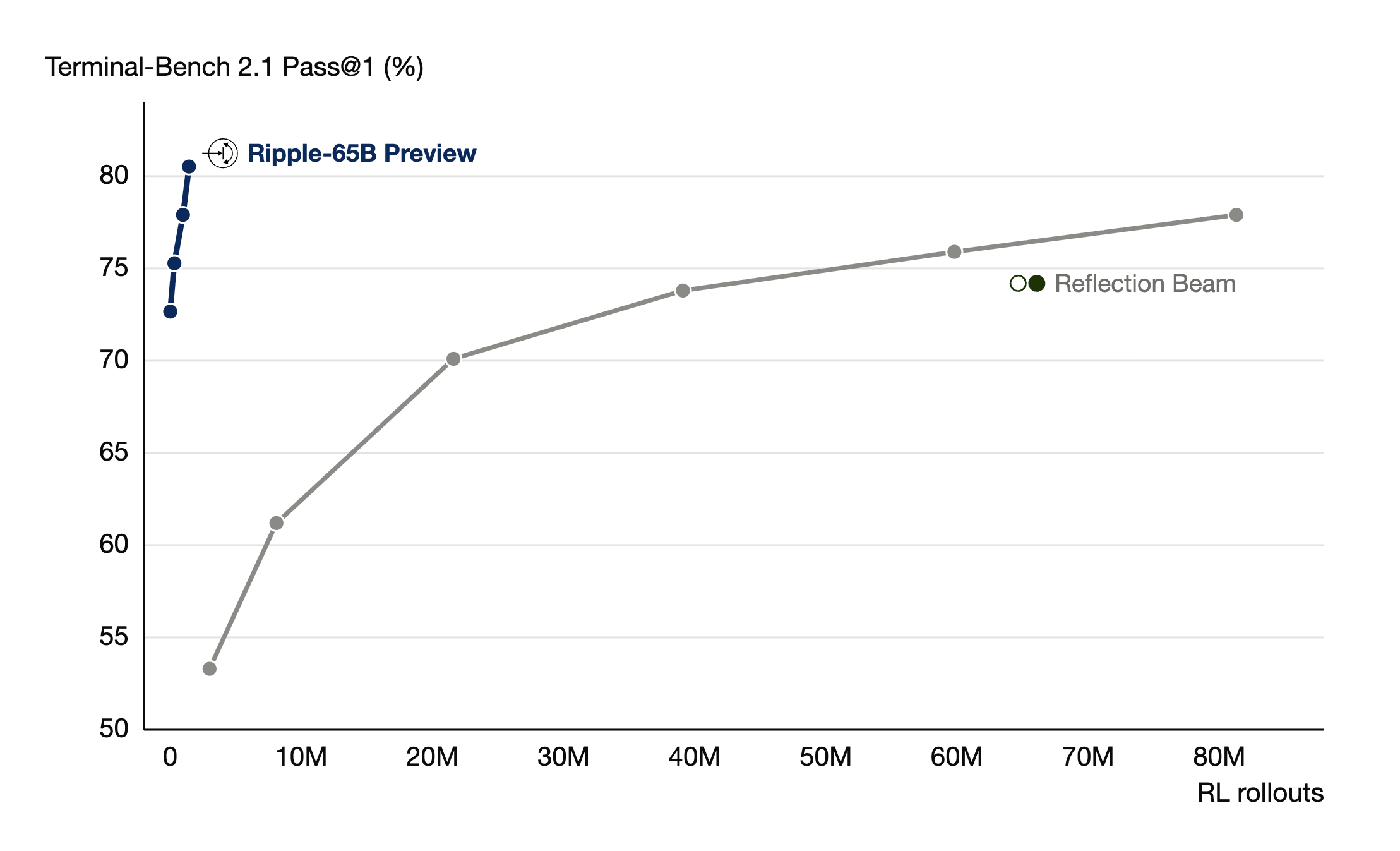
“Ripple was built on a $32 million compute budget, one-tenth the cost of the previous open-weight SOTA on agentic coding,” the company states in its own estimate, counting recipe-ladder work, data curation, evaluation, debugging, in-house synthetic-data generation, posttraining recipe development and the final hero run among the costs. For scale, the launch blog recalls a 2023 remark from OpenAI CEO Sam Altman putting GPT-4 training costs above $100 million, and cites Anthropic CEO Dario Amodei’s projection of $10 to $100 billion for frontier pretraining by 2026 to 2027; a footnote there cites outside reports that Reflection committed $150 million per month to SpaceX Colossus compute. The posttraining result: a mixed RL recipe using truncated importance sampling, score centering and a linear length penalty over long-horizon synthetic environments reached 80.5 on TerminalBench 2.1 with 1.4 million rollouts, roughly 70x fewer than Reflection Beam, the prior SOTA. The pretraining result: a 16x compute-efficiency win on code against the Olmo 3 baseline, achieved through a model ladder whose versions v1.0 to v1.6 tested StepFun batch-size and learning-rate scaling laws, pre+post norm, sigmoid gated attention, global NoPE, learning-rate cooldown to zero and value residuals, compounded to 16x measured by dolma_stack CE at 4B scale.
A thin-and-deep dense design chosen for serving simplicity
The architecture trades MoE routing for infrastructure simplicity: a modernized dense Transformer with a thin-and-deep aspect ratio, narrow d_model of 5120 and 80 total layers, migrated from an Olmo 3 llama-like design to a Gemma 3N-like one for stability during large-scale training. For reasoning, the design overprovisions attention heads while raising the SWA-to-global layer ratio and shrinking the SWA window to compensate; FFN activation clipping, value residuals, gated attention and global NoPE complete the block. “Ripple-65B Preview is a general-purpose variant of the proprietary model that powers our AI chip design platform,” the launch blog states, and the dense choice paid off immediately: the team trained from scratch at a solid 40 percent model utilization throughout pretraining and posttraining, “even with simple sharding, no custom kernels, and no quantization” (BF16), with the RL tasks tuned to the model’s capabilities and harder tasks added as the model improved.
Sized to run on one DGX Spark
The blog attributes the model’s deskside fit to dense architectures’ high compute FLOPs relative to memory bandwidth, compared to datacenter accelerators; the release is positioned for local devices such as the NVIDIA DGX Spark. The company reports its NVFP4 checkpoint “currently averages ~40 tok/s on DGX Spark” (reply). The release lists access through Hugging Face, GMI Cloud and OpenRouter at launch, with Together AI and Fireworks joining later the same day (availability post). That puts Ripple-65B in the same single-box serving class this blog has been tracking, from the DeepSeek-V4.1-Flash full-model fidelity check on one RTX 3090 and the GLM-5.3 full model across four Sparks to NVIDIA’s eight-node cluster coverage.
Independent replication is the next test
Community reaction moved fast. A practitioner run on the first day reported Qwen3.8-27B at 73.0, 61.7 and 42.2 on TerminalBench 2.1, SWE-bench Pro v2.0-Hard and DeepSWE v1.1 respectively, framing Ripple’s 80.5, 79.1 and 44.3 as punching well above a model with 38B fewer parameters, and declared an intention to “put this model through its paces and really validate these claims” (practitioner post). The company, for its part, puts the Qwen comparison at 73 percent against Ripple’s 80.5 percent on TerminalBench 2.1 (reply). Until independent runs land on the public leaderboards, treat the table as the lab’s report, not the fleet’s.
What the release says about the cost curve
Three numbers carry the argument. A five-person team, a $32 million budget and 1.4 million rollouts say the marginal cost of a frontier-adjacent agentic coding model keeps falling, and that a dense, serving-first architecture can now be competitive inside a single deskside box. The DFlash2 draft checkpoint in the family says the company intends its model to be speculated on and decoded fast, in the local-inference lane this blog covers. As firms such as 650 Group have been tracking in their AI infrastructure research, the open-weight frontier is trending toward smaller dense models co-designed with the hardware they serve, and that is the trend worth watching in this release.