
by Chris DePuy, 650 Group / October 21, 2026
The last month of desk-side serving stories were about engines. Athena put two frontier models on one 128 GB box at 262K context with a 141,519-token conversation restored from disk in 2.1 seconds; Imprint turned that same restore trick into a standalone context-cache service with a reported 19-second time-to-first-token falling to 0.3 — the pair was reviewed in September’s look at TensorFold’s exactness gates; and TensorFold, MCDMA and Drift gave the fleet speed, transport and shared memory. The quieter development, and the one I think matters more for anyone operating more than one box, is the layer that started to accumulate beside them: routing learned in the background, a control plane that watches every Spark’s memory and heat, and a transport that moves the speculative-decoding draft model off the cluster to buy back KV cache. Three projects, three maintainers, one direction of travel.
What is the management layer around a desk-side Spark fleet?
It depends on what a fleet lacks. An operator whose long jobs die in the third hour wants the watchdog: SparkPilot puts Spark memory, temperature and model control on an iPhone or iPad. An operator juggling several models across several machines wants the router: Syntra learns which backend should take each request and logs the evidence behind every choice. An operator tight on KV cache wants memory placement: remote-dspark moves the speculative-decode draft model onto a spare 10–24 GB GPU over TCP or RDMA, freeing about 2.8 GiB per node. All three are open source, and all three are young.
SparkPilot: a control plane with a watchdog inside it
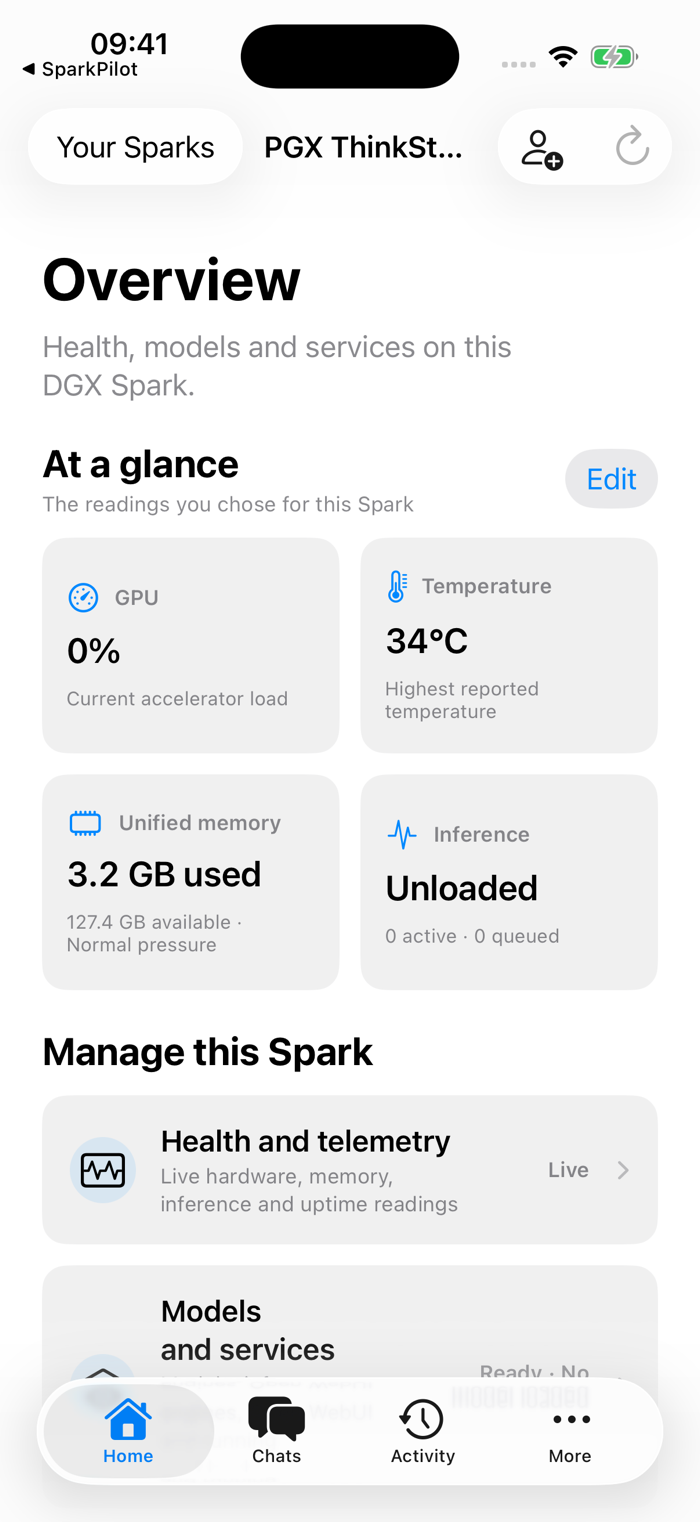
SparkPilot began as an admission: “I got sick of managing my DGX Sparks from the terminal, so I started building a native app for iPhone, iPad and Mac” — an August 27 post from a developer publishing under the name Ash Hart, who sketched a fresh Spark set up in a few taps, adding vLLM, anti-OOM protection and models that fit the box. On August 29 he announced the app itself, quoting that admission: onboarding Sparks and clusters, live telemetry, model management, Apple Foundation App Intents wired to local AI, one-tap launch for a favorite harness, and a beta due the following week. The project’s repository now describes a pairing of Apple devices with DGX Spark systems behind one authenticated Spark runtime, covering private chat sessions, model management and remote access — an interface built to feel like it shipped with the Mac, with a Rust daemon standing as the sole product gateway and vLLM bound to loopback behind it, and signed model and engine recipes defining what the app may install. The immediate beta scope, per the same documentation, covers Nemotron Lightning on the iPhone and the iPad. A month in, the lab that runs seven GB10-class boxes and five Mac Studios described the same project from the operator’s side in its September 26 roundup: SparkPilot watches memory pressure and heat on every Spark so long jobs do not crash — a use the repository’s own screenshots corroborate, with GPU load, temperature and memory use among the readings its Spark overview displays. The two descriptions mark the shift that matters: the watchdog job — the one vLLM operators used to do with a terminal open on a second monitor — moved into a consumer device app.
Syntra: routing learned in the background
The routing piece is the least documented of the three, and thin documentation is not the same as unimportant. In the same September 26 roundup, the same lab reported that Syntra learns routing decisions in the background rather than making an operator maintain static dispatch rules by hand. The project’s own documentation backs the framing with an unusually complete description: Syntra runs as a decision service the operator hosts, built on contextual-bandit learning. A calling application presents several candidate actions — the repository’s examples are which model answers a request and which backend serves it — takes one, and reports how it went, and the service learns from those reported outcomes. Each choice is recorded alongside the probability it was made with, which the project treats as evidence: from that log it estimates how a proposed change would have performed against the operator’s own traffic, and blocks any change from going live unless its own traffic evidence supports it. The SDKs hold the published model locally and answer in roughly a microsecond, the HTTP route answers in tens of microseconds, the whole service is one binary and one SQLite file, and the quickstart demo ships simulated LLM-routing traffic to watch it learn. If the fleet-routing use the lab described holds in practice, it closes the loop the September 23 field test opened: that test proved a fourteen-machine fleet could answer questions from KV cache that crossed an RDMA link between architectures; a learned router is the piece that decides where each new request should land in the first place.
remote-dspark: the draft model becomes a network citizen
Two days after that roundup, a third project attacked the same problem from the memory side. On September 28, a contributor whose gb10-vllm platform carried a 16-node Kimi K3 cluster documented on NVIDIA’s developer forums published remote-dspark, a set of vLLM mods that move the speculative-decoding draft model off the GB10 cluster and onto a spare consumer GPU with 10 to 24 GB of VRAM on the same network. The freed memory is the point. On the project’s worked example — GLM-5.3 in an Int4-Int8Mix quantization served tensor-parallel across four GB10s with the DSpark draft running on an RTX 3090 — the move frees roughly 2.8 GiB per node, more than 10 GB off the cluster in total, which the recipe directs into extra context capacity or a slightly better quantization. Two transports ship: a TCP lane over ZeroMQ, which the project describes as ported from an earlier branch of the same lineage and made model-generic, and a raw RDMA lane that skips the TCP/IP stack with ibverbs queue pairs, keeping TCPStore only for the initial peer exchange — a transport whose queue-pair state machine the project credits to an existing native reference implementation. The mods install into vLLM 0.29-based GB10 images in the mod format shared with the eugr Spark vLLM build harness and stay opt-in — unset the remote-address variable and the stock local draft runs, so a cluster can boot either way. One constraint: the external box must hold the target model’s shared embedding and output-head tensors once per target model, and a rowwise-FP8 switch halves that footprint so the whole server fits inside 10–12 GB, which puts an RTX 3060 or a 3080 in range alongside a 3090. The project reports validation with GLM-5.3 targets and Kimi K3 targets — the latter with the RedHatAI draft checkpoint — and notes the vision tower can follow the same path when an operator needs a little more memory back.
The three projects at a glance
| Project | Layer | What it does | Anchor figure |
| SparkPilot | Control plane and watchdog | Onboards Sparks, streams telemetry and manages models from an Apple device | Beta scope: Nemotron Lightning on iPhone and iPad |
| Syntra | Routing | Learns which model or backend serves each request; logs every decision for off-policy evaluation | Sub-microsecond decisions through local SDKs |
| remote-dspark | Memory placement | Moves the speculative-decode draft model to a spare 10–24 GB GPU over TCP or RDMA | About 2.8 GiB freed per node, more than 10 GB per four-node cluster |
What the layer changes for the buyer
None of these three makes a single token faster on its own, and that is exactly why they are worth tracking. The engines set the ceiling a buyer can reach; the layer around them decides how often the fleet actually operates at that ceiling. A cluster that crashes on the fourth hour of a long job, routes every request to the same box, or spends 2.8 GiB per node hosting a draft model it could rent out to a desk-corner GPU is a cluster that undersells its own engine. I treat all three as single-maintainer projects whose figures and descriptions are pending the replication this tier always eventually gets — Syntra’s routing description is the project’s own documentation put to fleet use in one lab’s report, SparkPilot is a young beta described by its author and one operator, and remote-dspark’s freed-memory figures come from the project’s own worked example. The direction, though, is visible across three independent maintainers at once: deskside fleets are growing the same software strata that datacenter clusters grew years ago — dispatch, telemetry, and memory placement — and they are growing it in the open. As firms such as 650 Group have been tracking in their AI infrastructure research, the deskside tier’s competitive frontier has moved past whether a cluster can serve a frontier model to whether it can be operated — and in one four-week window, the community published a router, a control plane and a memory-placement transport as open-source answers.