
by Chris DePuy, 650 Group / November 9, 2026
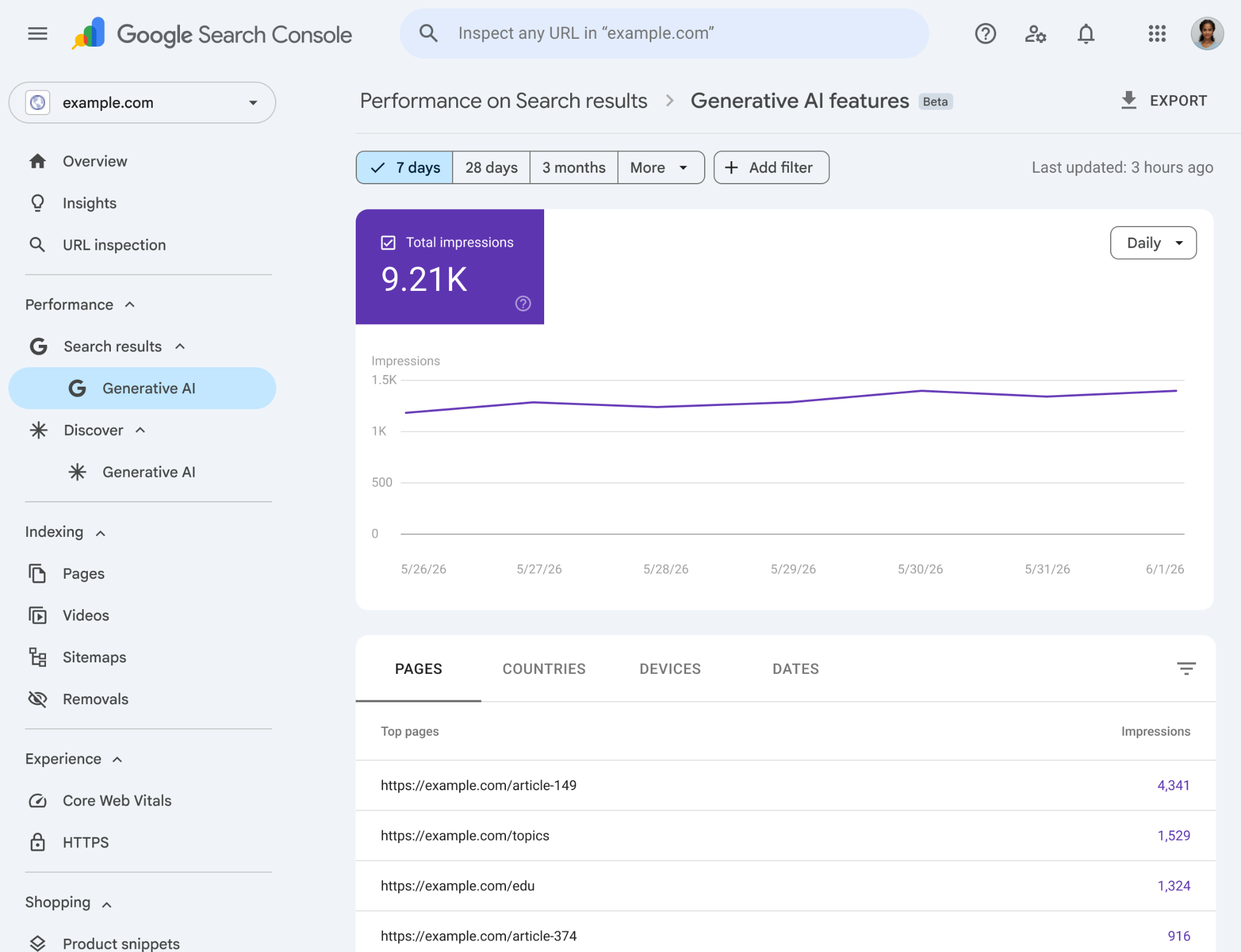
Google’s Search Generative AI performance report has been available to every website in Search Console since August 31, 2026, counting AI impressions inside AI Overviews and AI Mode. The quantity Google publishes is presence inside its own AI answers, not the click out of them, and that single design choice now sets the boundary of what a buyer can defensibly purchase in the AI-visibility market.
What Google Ships, and When It Shipped It
The report fits a specific reader and not another. It is the right instrument for the enterprise marketing buyer who must prove Google-surface visibility from first-party data rather than from a vendor screenshot, and it is the wrong instrument for the reader whose demand arrives through ChatGPT, Claude or Gemini, because Google’s console cannot see those engines at all. The deciding constraint is which surface the traffic is supposed to come from.
The dating of the feature matters to both readers, because the calendar is not the one the promotion around it implies. Google announced the Search Generative AI performance reports on June 3, 2026, in a post from Hillel Maoz, Search Ecosystem Engineering Manager, and Moshe Samet, Product Manager Lead for Search Console, which described the staged opening plainly: “We are rolling these reports out to a subset of websites, allowing us to thoroughly test them and receive feedback before making them widely available.” Google’s own help documentation closes that sequence with a date: “As of August 31, 2026, we’ve rolled out these insights to all websites worldwide.”
The shipped surface is narrow and specific. The report counts impressions for two named capabilities, AI Overviews and AI Mode, and Google’s definition of the unit is exact: “Impressions are how many times links to your site were shown to a user in a generative AI feature on Google Search.” Dimensions available for grouping are pages, countries, dates and devices, dates are reported in Pacific Time, and the report carries an export button for the chart and table data. A property that sees no report is told to expect that it has not received enough impressions in those features, or has excluded itself from them.
The practitioner traffic around this feature has run ahead of its own calendar. A walkthrough posted October 17, 2026 presents the report as recent news and attributes to Mueller that “Google is rolling it out incrementally and reviewing feedback along the way,” a formulation from the June rollout window; the same account had published a near-identical walkthrough on September 25, 2026. The recycling is itself the finding a buyer should note: the measurement surface settled in late summer, and the marketing conversation about it arrived months later.
Why an Impressions-Only Meter Changes the Buying Conversation
Google publishes presence, not the click, and the operator community now states that gap more bluntly than the vendor documentation does. In his October 27 post, the practitioner behind the attached account article writes “Search Console has a Generative AI report now. Almost nobody opens it,” and sets his own limit on the number: “AI impressions are not clicks. They show you’re being seen inside AI answers, not that people clicked.” His series, published in that article, moves from 9,090 AI impressions in June 2026 to 92,089 in September and 196,196 in the first 25 days of October, with a best day of 12,138, beside a rise in Google clicks from 328 to 18,036 per month over 11 months. He scopes it himself: “This is one site. Your niche and competition will change the numbers.”
Two conclusions follow for anyone signing an AI-visibility invoice. The first is that a first-party series from Google is the only defensible Google number, because a screenshot of one prompt answered once measures one draw rather than a distribution, the kind of draw that moved between repeat runs in the four-engine test below. The second is that the missing click metric becomes the commercial opening: the report ranks vendors by whether they can explain a presence curve they did not produce, and the party that later attaches a click figure to AI answers inherits this market.
One Console Does Not Cover a Multi-Engine Question
The narrower point is coverage. A four-engine citation study published the same October 17, 2026 morning, about two and a half hours before the walkthrough above, reports that the firm Prefer ran a fixed 80-question set three times each through ChatGPT, Perplexity, Gemini and Claude, producing 960 answers and 1,329 distinct cited sites. Of those, 966 appeared in exactly one engine, 205 in two, 129 in three and 29 across all four. Per-answer source counts separated sharply by engine, averaging 19.48 on Perplexity, 8.64 on Gemini, 4.58 on Claude and 3.05 on ChatGPT, and repeat runs of the identical question agreed only 96% of the time on Perplexity, 68% on Claude, 37% on ChatGPT and 35% on Gemini. The post scopes its own reach: that set was built around AI-search, GEO and AEO work, and the author’s caveat is that a healthcare, finance, ecommerce or local-service question set could land a very different mix.
That is the measurement picture Search Console cannot reach on its own, and it is the reason the report should be read as a Google-surface instrument rather than as an AI-visibility dashboard. Google’s position is that its generative features are not a separate ranking system at all. The October 17 walkthrough relays that position in Google’s own words, that AI Mode and AI Overviews “retrieve up-to-date content from Google’s existing search index” and that the generative features are “rooted in the same core ranking and quality systems as traditional Search,” a statement the post files under what it calls Google’s “Good SEO is good GEO” guidance. The buying consequence is that the unglamorous foundation decides both outcomes at once, crawlable pages, clear product information, attributed authorship, entity clarity and third-party validation, and that the same work raises the Google impression count while it leaves the non-Google engines to be measured elsewhere. The metering question runs on the supply side too, as Cloudflare’s 46-announcement AI week showed an infrastructure vendor pricing the machines that come to read the page, and in the serving stacks themselves, where DeepSeek’s open-sourced DeepInfer and NVIDIA’s answer map the layer underneath the answers. Google’s own silicon line moves in the same market, which is the wider point: the company supplying the answer surface is also supplying the compute underneath it.
The reading I would give a buyer is procedural. Ask any AI-visibility provider for two series before the contract is signed, a first-party Search Console impression curve on Google’s surfaces and a repeated-draw citation count outside them, because the first cannot be fabricated by the vendor and the second cannot be skipped by a vendor who only sells against Google. As of November 2026, a provider that produces neither is narrating a market that Google finished instrumenting over the summer.
As firms such as 650 Group have been tracking in their AI infrastructure research, the console that first reports a metric sets the terms of the market that forms around it, and the measurement gap left open, here the click out of an AI answer, is where the next vendor tier gets priced.